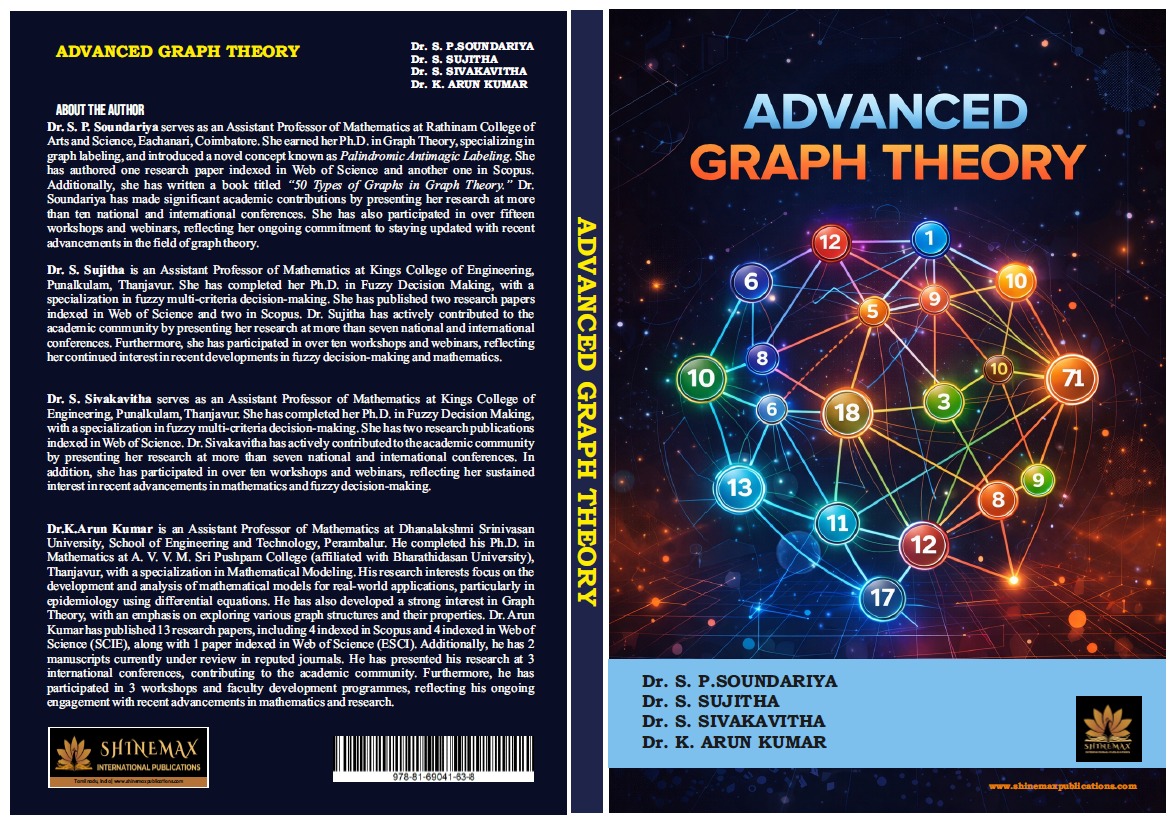
About This Book
Graph Theory has emerged as one of the most dynamic and widely applied branches of mathematics, influencing diverse fields such as computer science, engineering, operations research, social networks, communication systems, biology, and artificial intelligence. Over the years, the subject has evolved from a purely theoretical discipline into a powerful tool for solving real-world problems involving connectivity, optimization, and network analysis.
This book, Advanced Graph Theory, is designed to provide students, researchers, and academicians with a deeper understanding of advanced concepts in graph theory and their practical significance. The content has been carefully organized to bridge the gap between foundational knowledge and contemporary developments in the field. Special emphasis has been given to clarity of presentation, mathematical rigor, and application-oriented approaches.
The topics discussed in this book include advanced graph structures, graph operations, connectivity, domination, coloring, labeling, network models, and emerging research areas in graph theory. Wherever possible, definitions are supported with illustrative examples, theorems are presented with clear explanations, and problems are included to encourage analytical thinking and independent exploration.
This book is primarily intended for postgraduate students, research scholars, and educators in mathematics and related disciplines. It may also serve as a useful reference for professionals and researchers working in areas where graph-theoretical methods are applied.
The authors sincerely hope that this book will inspire readers to explore the beauty, depth, and wide-ranging applications of graph theory. We believe that the study of advanced graph theory not only strengthens mathematical reasoning but also opens pathways to innovative research and interdisciplinary problem-solving.
We express our heartfelt gratitude to our colleagues, students, institutions, and well-wishers who encouraged and supported us throughout the preparation of this book. We also extend our appreciation to the publishers for their valuable cooperation and support.
We welcome constructive suggestions and feedback from readers, which will help us improve future editions of this work.
Dr. S. P. Soundariya
Dr. S. Sujitha
Dr. S. Sivakavitha
Dr. K. Arun Kumar