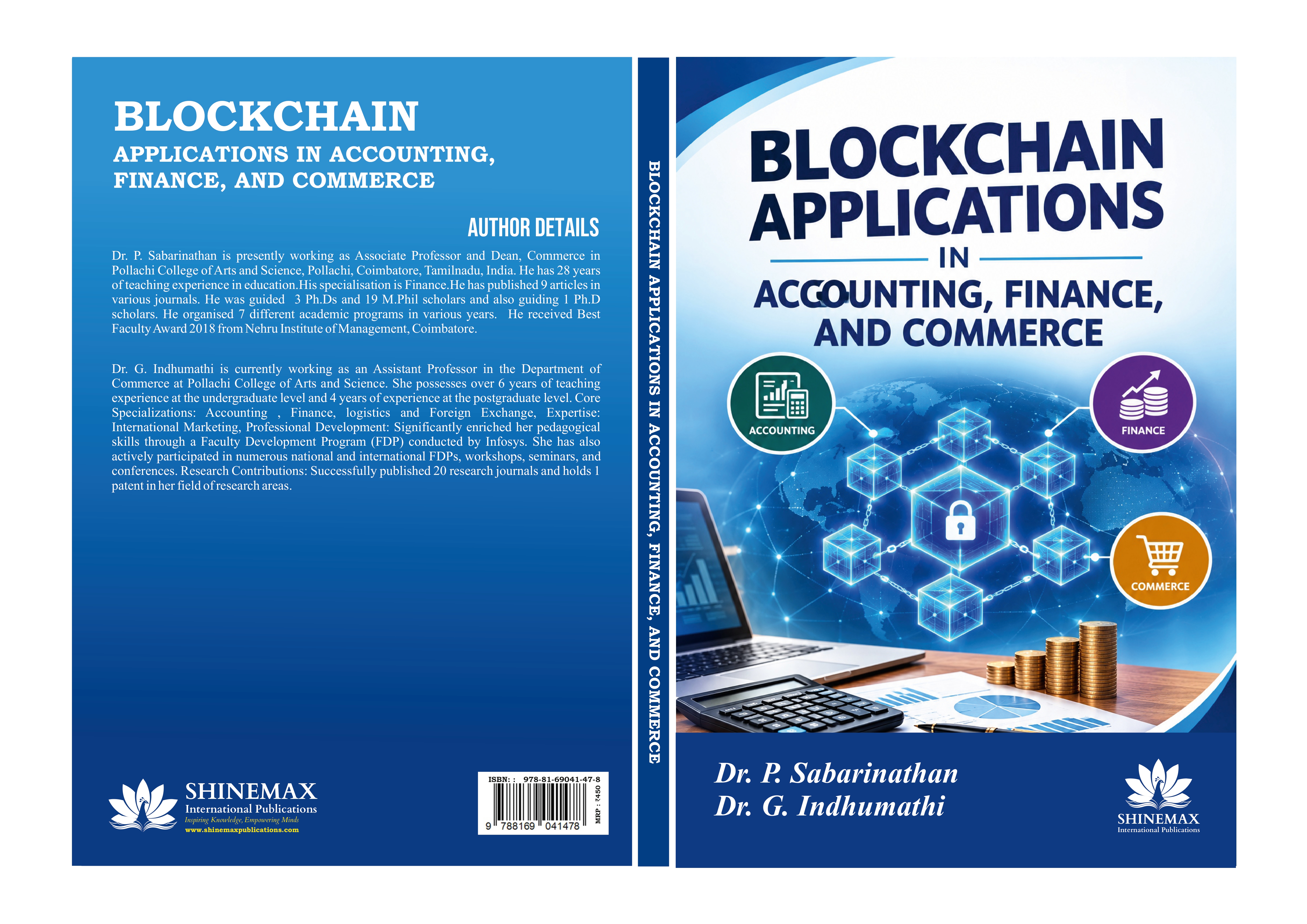
BLOCKCHAIN APPLICATIONS IN ACCOUNTING, FINANCE, AND COMMERCE
About This Book
The rapid development of digital technologies is transforming the way organizations record transactions, manage financial information, conduct business, and interact with customers. Among these technologies, blockchain has emerged as an important innovation with the potential to reshape accounting, finance, and commerce. By providing a distributed, transparent, and tamper-resistant approach to recording transactions, blockchain offers new possibilities for improving trust, efficiency, security, and accountability across financial and commercial activities.
Blockchain Applications in Accounting, Finance, and Commerce is designed to provide a structured and comprehensive understanding of blockchain technology and its practical applications across these interconnected fields. The book introduces the fundamental concepts of blockchain before examining how distributed ledger technologies can influence accounting systems, financial services, digital transactions, auditing, taxation, supply chains, and electronic commerce.
The book begins with the foundations of blockchain technology, including its architecture, characteristics, distributed ledger systems, and consensus mechanisms. Understanding these fundamentals is essential for recognizing how blockchain differs from conventional centralized databases and why it has attracted significant interest from financial institutions, businesses, governments, and technology professionals.
A major focus of the book is the application of blockchain in accounting and auditing. Traditional accounting systems depend heavily on centralized records and reconciliation processes. Blockchain introduces the possibility of shared financial records that can be verified by authorized participants. Concepts such as triple-entry accounting, real-time record keeping, continuous auditing, transaction verification, and fraud detection are therefore explored to demonstrate how blockchain could improve financial transparency and accountability.
The book also examines the growing role of blockchain in financial services. Applications involving digital payments, cross-border transactions, trade finance, securities settlement, asset management, cryptocurrencies, and digital assets are discussed. These applications demonstrate how blockchain can potentially reduce transaction friction, improve settlement processes, and create new forms of financial infrastructure while also introducing technical, operational, and regulatory challenges.
Smart contracts represent another important area covered in this book. These programmable agreements can automate specific actions when predefined conditions are satisfied. Their applications in payments, settlements, financial agreements, compliance, and commercial transactions illustrate how blockchain can support greater automation and reduce dependence on manual processes.
The book further explores blockchain applications in digital commerce and supply chain management. Product traceability, transaction transparency, consumer trust, digital payments, and blockchain-based business models are examined to show how the technology can influence relationships between businesses, suppliers, intermediaries, and customers.
The Authors:
Dr. P. Sabarinathan
Dr. G. Indhumathi