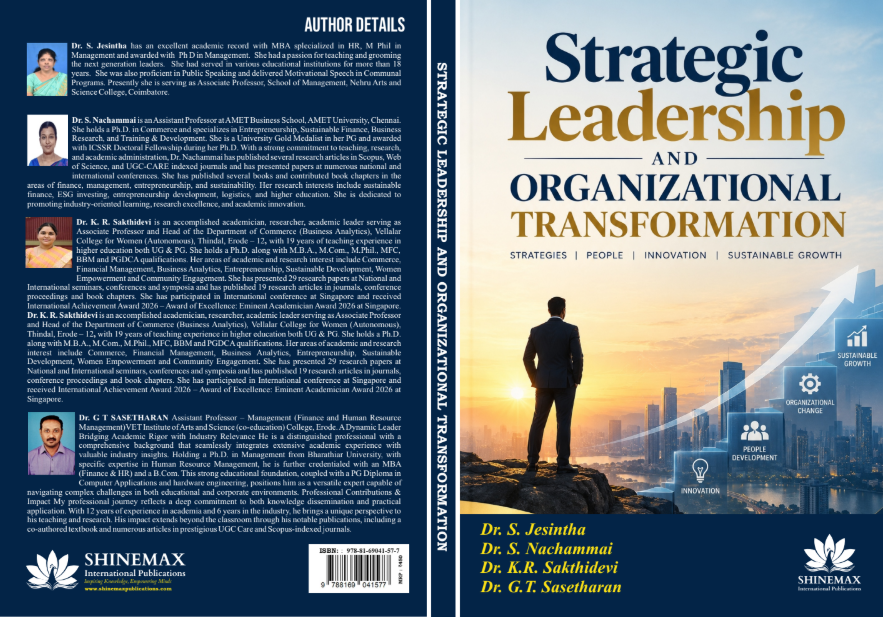
STRATEGIC LEADERSHIP AND ORGANIZATIONAL TRANSFORMATION
About This Book
The book also provides detailed attention to change management and organizational transformation. It examines the drivers of change, established change management approaches, resistance to change, and strategies for implementing transformation successfully. The emphasis is placed on understanding transformation as a continuous organizational process rather than as a single event.
In modern organizations, strategic decisions increasingly depend on information, technology,
and analytical capabilities. The book therefore addresses strategic decision-making, critical
thinking, problem solving, data-driven decisions, risk management, and ethical leadership.
These concepts help leaders evaluate alternatives and make informed decisions in
situations involving uncertainty and complexity.
Digital transformation represents another major theme of the book. The integration of
artificial intelligence, automation, cloud technologies, data analytics, and other emerging
technologies is changing organizational structures and business processes. The book
examines how leaders can manage technology-driven transformation while maintaining
strategic alignment and organizational readiness.
Innovation and organizational agility are also essential for organizations operating in rapidly
changing environments. The book discusses creativity, innovation management, agile
leadership, organizational resilience, and adaptive capabilities. These areas highlight the
importance of creating organizations that can learn, experiment, respond, and continuously
improve.
People remain central to every organizational transformation. The book therefore examines
strategic human resource management, talent development, employee engagement,
leadership development, succession planning, motivation, and high-performance teams.
Successful transformation requires not only new strategies and technologies but also people
who understand the purpose of change and are prepared to participate in it.
Effective transformation also depends on communication and collaboration. The book
explores leadership communication, stakeholder management, teamwork, knowledge
sharing, conflict management, and negotiation. These capabilities help leaders build
understanding, strengthen relationships, and coordinate transformation across different
levels of an organization.
The later chapters focus on strategy execution and performance management, examining
how organizations translate strategic plans into measurable actions and outcomes. Key
performance indicators, accountability, continuous improvement, and alignment between
people, processes, and strategy are considered essential components of successful
strategic execution.
The final chapter considers the future of strategic leadership and organizational
transformation, including emerging leadership practices, changing workplace models,
sustainability, responsible leadership, and organizations operating in uncertain and rapidly
changing environments. It encourages readers to view transformation as an ongoing journey
that requires learning, adaptability, innovation, and responsible leadership.
Author Details :
Dr. S. JESINTHA
Associate Professor
School of Management
Nehru Arts and Science College, Coimbatore
Dr. S. Nachammai,
Assistant Professor,
AMET Business School,
AMET University, Chennai
Dr. K.R.Sakthidevi
Associate Professor & Head
Department of Commerce (Business Analytics)
Vellalar College for Women (Autonomous), Erode
Dr. G T Sasetharan
Assistant Professor
Department of Management (Finance and Human Resource Management)
VET Institute of Arts and Science (co-education) College, Erode